
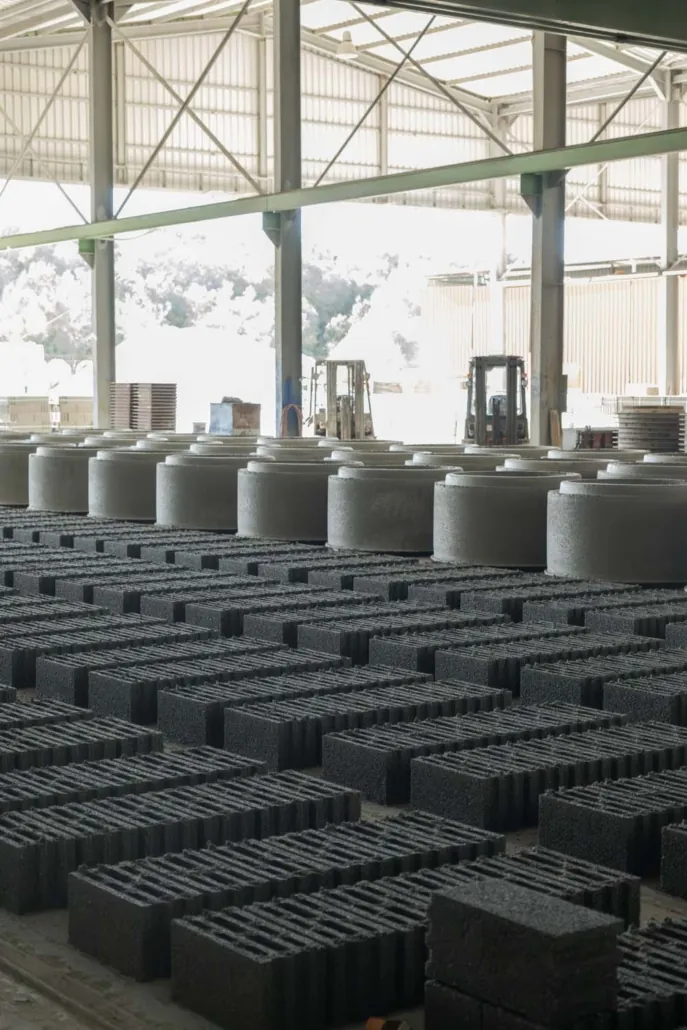
Whether a sewer or stormwater line is still working years later depends less on the pipes than on the manholes. The inspection chamber, or manhole, is the only point where the line can be entered, cleaned and inspected; it is where changes of direction and diameter, and junctions, are resolved. Cast-in-place manholes have largely given way to precast concrete elements: base, shaft ring, cone, adjusting ring and cover fit together with gaskets, and installation is finished in a few hours. But choosing the right elements, seating the gasket correctly and backfilling properly are what turn that speed into a lasting line; the hours saved on installation day turn into an excavation years later if a gasket was seated wrongly.
What Does a Manhole Do?
A manhole is not just a shaft with a cover on top. It serves three basic needs of the line. Access: A blocked line is inspected by camera and cleared by water jetting, and all of this is done from the manhole. A line without manholes is a line that gets dug up when it blocks. Change of geometry: Pipes are laid in straight lines; wherever the line changes direction, gradient or diameter, that change is resolved inside a manhole. Trying to swing a pipe round a curve, or to fit two different diameters directly into each other, is creating a blockage point. Junctions: Plot connections and branch lines join the main line inside the manhole, so every connection can be seen and checked.
On stormwater lines the manhole has one more job: to regulate the speed and direction of water arriving fast in a downpour and, where needed, to retain settled material. On sewers, the correct working of the manhole cover and gaskets matters for venting gases and controlling odour.
Manhole Elements: Base, Shaft, Cone, Ring, Cover
A precast manhole is made up of the following elements, from bottom to top:
- Base unit: The unit the manhole stands on, with a closed floor and the pipe entries. Inside it are the channel (invert) in which the water flows and, on either side, the benching that is stood on for maintenance. Shaping the channel to the pipe diameter and the change of direction prevents water pooling and silt settling inside the manhole. Pipe entries are either formed in the factory with gasketed sockets or core-drilled on site and connected with a purpose-made wall-penetration seal.
- Shaft rings: The cylindrical units that sit on the base and make up the depth of the manhole. They are produced in different heights, and the required depth is achieved by combining them. Their inner face carries step irons for climbing down.
- Cone (taper unit): The unit that reduces the shaft diameter to the cover diameter. In an eccentric cone the taper is offset to one side, so the step irons stay in a straight vertical line and climbing down is safe. A concentric cone tapers centrally; it is used in shallow manholes and where there are no step irons.
- Adjusting (raising) rings: Shallow rings placed on top of the cone. They bring the cover level exactly to the finished road level. One or two rings is normal; stacking ring on ring to close a large level difference puts the most fragile zone directly under the load.
- Frame and cover: The part that closes the manhole and is exposed to vehicle loads. It may be cast iron or composite; its class is chosen to TS EN 124 according to where it is used (from A 15 to F 900). On carriageways D 400 is standard. On sewers, whether the cover is ventilated or solid is a design decision that weighs odour against safety.
Between these units, at every joint, there is a gasket. The gasket is either ordered as a separate item or comes factory-fitted to the units; discovering on site that it is missing means the installation stops for the day.
Which Standards Apply: TS EN 1917, TS EN 124, TS EN 681-1
The product standard for concrete manholes and manhole elements is TS EN 1917; it covers unreinforced, steel fibre and reinforced concrete elements. The standard defines crushing strength under vertical load, dimensional tolerances, water absorption, the watertightness of gasketed joints and reinforcement cover. TS EN 1916, from the same family, covers concrete pipes; when pipe and manhole come from the same family of standards, the connection components fit each other.
TS EN 124 applies to covers and frames. The load classes are defined on the same logic as drainage gratings: A 15, B 125, C 250, D 400, E 600 and F 900. B 125 or C 250 is chosen for footways, D 400 for carriageways and E 600 for industrial sites; a footway fitted with A 15 because it is 'pedestrian only' and later driven over ends up with a broken cover.
Gaskets are made of elastomeric material under TS EN 681-1. This standard defines the hardness, compression set, ageing and ozone resistance of the gasket. A non-standard gasket, or one that has hardened or been left out in the sun, looks watertight during installation but hardens and starts to leak within a few years.
The internal diameter of the elements is, in common practice, in the order of one metre; smaller diameters are used on shallow, small-bore lines and larger ones on large-diameter collectors. The choice of manhole diameter depends on the diameters of the pipes entering it and on whether anyone will work inside it; a manhole in which a person cannot turn and work comfortably is a manhole that never gets maintained.
Gaskets and Watertightness: Infiltration and Exfiltration Are Both Problems
Watertightness in a manhole works in both directions. Exfiltration (leakage out): Sewage seeping from the manhole joints into the soil; it pollutes the groundwater, softens the ground around the manhole and the manhole gradually settles. Infiltration (seepage in): Groundwater entering the manhole; it increases the flow the line has to carry, adds to the treatment load and, by carrying fine material with it, washes out the ground around the manhole. Along the Bodrum coast the water table is high and saline; infiltration fatigues both the line and the concrete.
There are three points that provide watertightness:
- Element joints: The base-to-shaft, shaft-to-shaft, shaft-to-cone and cone-to-ring joints are sealed with an elastomeric gasket seated in the spigot-and-socket groove. The gasket groove must be clean, the gasket lubricated, and the upper element lowered vertically. An element that comes down at an angle crushes the gasket on one side and pushes it out of its groove on the other; this is a leak that cannot be seen but shows itself in the first rain.
- Pipe entry points: The point where a pipe passes through the manhole wall is the weakest point of all. Factory-formed entries with gasketed sockets are the safest solution. Where entries are core-drilled on site, a purpose-made wall-penetration seal is used; simply rendering the gap with mortar produces a connection between a pipe and a chamber that settle differently, and it cracks within the first year.
- Cover and frame: On sewers the joint between the frame and the ring is also sealed with mortar or a purpose-made sealant; surface water entering through the manhole loads the line unnecessarily.
Once installation is complete and before backfilling, filling the manhole with water and watching the level is the way to catch a leak at the cheapest stage. A leak found after backfilling means excavating again.
Layout on the Line: Where Do Manholes Go?
The principles that decide where manholes go on a line are the same for sewers and for stormwater:
- At every change of direction: Every point where the line turns in plan is a manhole. No angle is formed between pipes.
- At every change of diameter: The transition from a smaller to a larger diameter is made inside the manhole; the channel (invert) must be shaped accordingly.
- At every change of gradient: Every break in the vertical profile of the line is a manhole. Where there is a large drop in level a backdrop manhole is used: the incoming pipe enters the chamber high up and is brought down to the base by an external or internal drop pipe, so that free-falling water does not erode the manhole floor.
- At every junction: The points where branch lines and plot connections join the main line.
- At the head of the line: The highest point of the line starts with a manhole so that cleaning equipment can enter.
- On long straight runs: Even with no change of direction, intermediate manholes are placed at intervals that cleaning and camera equipment can cover from one manhole to the next. This spacing depends on the pipe diameter, the type of line and the specification of the relevant authority; the value given in the design is followed.
On stormwater lines, manholes are laid out on the same principles; in addition, the points where surface gullies and drainage channel silt traps connect are usually made to coincide with a manhole. Sewer and stormwater manholes stay on separate lines and in separate chambers; combining the two in one manhole means sewage rising to the surface in a downpour. We covered the stormwater collection side in our stormwater drainage article.
Installation Sequence: Step by Step from Excavation to Cover
- Excavation: The manhole pit is dug to the outside diameter of the element plus working room. Deep excavations are shored; a deep pit with neither battered sides nor shoring is an accident waiting to happen before installation even starts.
- Preparing the formation: The bottom of the pit is compacted; a bed of either blinding concrete or compacted sand and gravel is placed on it and levelled. If the base unit sits at an angle, every element above it goes a little further out of true and the cover level at the top will not work out.
- Placing the base unit: The channel direction is aligned with the axes of the incoming and outgoing pipes. This is the step with no way back; if the base is seated facing the wrong way, the pipe connections are forced.
- Pipe connections: The inlet and outlet pipes are fitted into gasketed sockets or wall-penetration seals. The pipes must sit on their own bedding rather than bearing on the manhole wall as a support; for pipe-laying details see our laying concrete pipes article.
- Shaft rings: The gasket groove is cleaned, the gasket fitted and lubricant applied. The ring is lowered vertically by crane; the weight of the element itself seats the gasket. The step irons are aligned in a single line.
- Cone: Placed with the same gasketed joint. In an eccentric cone the taper is set opposite the line of step irons.
- Adjusting rings: Only as many rings as needed to bring the cover to road level are placed; the joints between rings are gasketed or mortared.
- Frame and cover: The frame is bedded on the ring with mortar or a purpose-made bedding pad, and its level and crossfall are matched to the road surface. If the manhole has to be finished before the road is built, the frame is adjusted one last time when the road is surfaced.
A crane and suitable lifting equipment are essential for installation; lowering elements by hooking chains onto their edges breaks the gasket and the spigot edge. A broken spigot edge does not give a watertight joint.
Backfill: The Final Step That Keeps the Manhole Standing
The manhole itself carries the vertical load, but its lateral stability and freedom from settlement depend on the fill around it. Backfilling follows these principles:
- Material: Large stones, rubble and soft soil are not used. Compactable granular material, or the screened fraction of the excavated material, is used instead. A large stone bearing against the manhole creates a point load and cracks the concrete element.
- Placing in layers: The backfill is placed around the manhole in layers of equal height; filling one side while leaving the other empty pushes the chamber sideways and opens the gaskets. Each layer is compacted.
- Compaction: Light equipment is used close to the manhole and heavy equipment further away. A heavy roller bearing against the side of the manhole breaks the element.
- Around the pipes: The fill beneath and beside the pipe entry points is compacted with care; if a void is left, the pipe settles and the entry seal is strained.
- Around the cover: Under a road, the final layer around the frame is finished with concrete or with heavy compaction. When the road surface sinks around a manhole, it is usually because this last layer was left loose.
Uncompacted fill settles in the first winter once the ground becomes saturated; the cover ends up below road level, vehicles hit the manhole with every pass and the adjusting rings break. This cycle explains why backfilling is not the last step of installation but the most important one.
Pre-Handover Checks and the Right Supply
Three checks made before backfilling mean a manhole that will not be dug up later: a visual check of the channel direction and pipe connections, the verticality of the element joints and the seating of the gaskets, and a watertightness test by filling with water. After backfilling, the cover level and the fit of the frame with the road surface are checked.
The right elements matter as much as correct installation: a base channel shaped to the pipe diameter, shaft heights that reach the design depth without excess rings, gaskets supplied with the elements, and a cover class that suits the location. At Bodrum Boru we manufacture manhole elements at our Milas facility in the same family of standards as our concrete pipes, so that they fit each other. You can find the product group on our precast infrastructure products page and the matching pipe options on our reinforced concrete pipes page, and reach us through our contact page for an element list tailored to your project.
Frequently asked questions
What is the difference between an eccentric and a concentric cone?
In an eccentric cone the taper is offset to one side; the step irons stay in a straight vertical line and climbing down is safe. A concentric cone tapers from the centre; it is preferred in shallow manholes and where there are no step irons. In deep manholes that will be entered, the eccentric cone is standard.
How many adjusting rings can be used?
One or two rings is normal. Stacking a large number of rings to reach the cover level puts the weakest zone directly under the traffic load; the rings break and the cover rocks. A large level difference is closed with a taller shaft ring or a suitable choice of cone.
Where should manholes be placed?
A manhole is placed at every point where the line changes direction, diameter or gradient, wherever branch lines join, and at the head of the line. On long straight runs, intermediate manholes are placed at intervals that cleaning equipment can reach; this spacing is set in the design and in the specification of the relevant authority.
Why is it important to use gaskets rather than mortar between manhole elements?
Mortar is rigid; it cracks and leaks with ground settlement and thermal movement. An elastomeric gasket accommodates these movements and keeps the joint watertight. Elements under TS EN 1917 are designed for gasketed joints, and the gaskets must comply with TS EN 681-1.
Can sewer and stormwater be combined in the same manhole?
No. The two systems stay in separate manholes and on separate lines. The volume of stormwater in a downpour overwhelms the sewer and sewage rises to the surface. Stormwater manholes are placed on a separate line, arranged so that the surface gullies and drainage channels connect to it.
What material should be used for backfill?
Large stones, rubble and soft soil are not used. Compactable granular material is placed around the manhole in layers of equal height and each layer is compacted. Light equipment is used close to the manhole; a heavy roller breaks the element.
Related articles
Guide to Building Walls with Pumice Blocks: From Selection to Render
What Is a Hollow Block Floor System, and Where and How Is It Built?
Choosing the Strength and Load Class of Concrete Pipe: What to Check in the Design
Kerb Stone Types and Laying Rules: What to Watch on Site
Stormwater Drainage: Channels, Grating Classes and Ditch Elements
Laying Interlocking Pavers: Ground Preparation, Sand Bed and Joints
Laying Concrete Pipes: Trench, Bedding, Seals and Joints
Let us prepare a product and delivery plan for your project
Contact our plant management for stock availability, size options and a price quote. Same-day delivery from our facility at the centre of the Milas–Bodrum axis to Milas, Bodrum, Muğla, Didim and the surrounding areas.